I Cannot Die — Part II

I Cannot Die — Part II
In search of a god-slaying sword, I arrived at Buddhism. There the self vanished and became the universe. And there I met my deepest fear. This is the experience that became the core of spirit in physics.
There Was No Me, No Self
I took part in zazen and training held in Kamakura, and my understanding of Buddhism deepened. There I learned something deeply interesting.
All is emptiness. All things are impermanent. All phenomena are without self. Nirvana is stillness.
There was none of the “being” that the Bible, that the West, takes for granted. There was no me. There was no self.
From there, through philosophy and logic, I doubted: “That I exist” — is even this open to doubt?
Enryaku-ji on Mount Hiei
At twenty-five, to study Buddhism more seriously, I began training at Enryaku-ji on Mount Hiei.
It is the head temple of the Tendai school, founded by Saichō, where many of the founders of Kamakura Buddhism — Hōnen, Shinran, Eisai, Dōgen, Nichiren — once trained. Called the “mother mountain” of Japanese Buddhism, it is one of its highest peaks (Groner, 2000).
As I studied the Dharma broadly and trained, I came to understand, and to feel in the body: I do not exist. I exist within relation.
Ayahuasca — Time Compressed
At twenty-seven, as part of my training, I was taken to ayahuasca (cf. Shanon, 2002).
The experience there was magnificent.
Time was compressed. Not hours, but centuries — that was what I lived. There I was not a person. I was the past, I was air, water, a fish, a bird, a cat.
There was no separation of self and other. I was the universe, and the universe was me. I felt it in the body.
Wondering whether I could go deeper than that insight, I repeated the ayahuasca experience several times, but I never found anything beyond it.
The Terror of Being Unable to Die
And at the same time, I became terrified.
Because I cannot die.
The body I had believed in, consciousness, that closed perception. The fruit of knowledge. The fruit of discrimination. The world that divides things. And the world in which even I and God are divided.
When that boundary blurred and was undone, when I became the universe, I felt terror.
Because the insect I just crushed, the bird I ate, the fish — they are me. I kill myself. I devour myself. Even air and soil are me. The future too. The whole of the past. God too.
I cannot die. I am unable to die. I cannot end. It repeats. Samsara repeats. Even when the universe closes, it expands again. Some nth universe. Rebirth. I was terrified, deeply, deeply.
A Fear Unknown to a Christian
And I understood. So this is the fear of Brahmanism, of Buddhism — samsara.
To me, who had been a Christian, it was a fear with no foothold.
What I had feared until then was finitude, death. The vanishing of me as me.
But the fear of Buddhism is not there. It is that I cannot die. Infinity. That I am unable to die as myself.
To kill another being — a living thing that is me — is terrifying. Because in the next universe it may be me, and I may be the one killing myself.
The Answer Already Existed — Liberation
Fortunately, more than 2,500 years ago, the Buddha had already found the answer there.
Liberation. Moksha.
How does one escape this samsara? And how should I conduct myself? The old masters and the founding patriarchs had answered.
Effortless naturalness — wu wei, which originates in Daoism (Laozi, Dao De Jing).
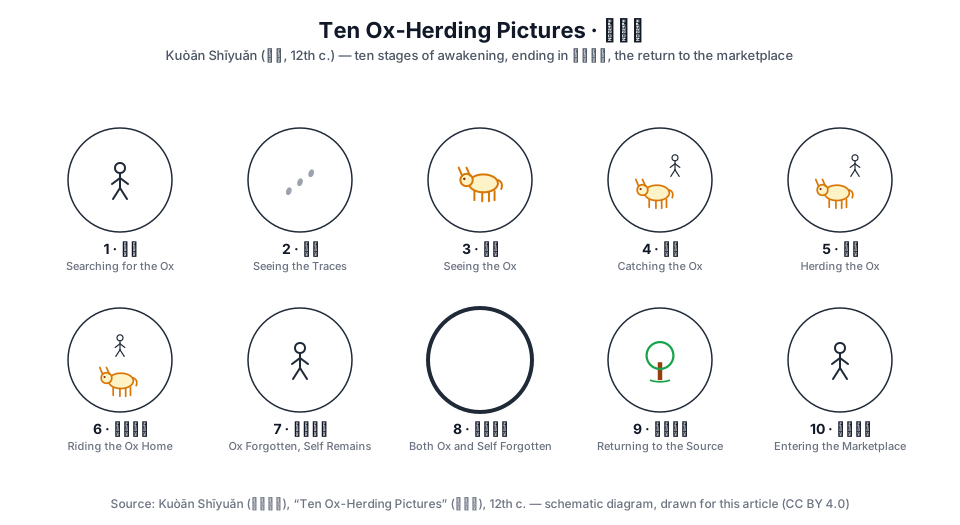
In China it merged with Chan, and it flows on into Japanese Zen. Having passed through awakening, what does one do afterward? That is depicted in the Ten Ox-Herding Pictures (Kuòān, 12th c.).
To simply live — naturally, without contrivance.
The Expanded Self, and Its Suffering
The self that expanded afterward has no boundary. So I can become a friend, a family member, of anyone.
But to be able to share joy is, at the same time, to share sorrow. There is a gradient, too. Of character. Even with a person whose heart I feel to be bad, very bad, I understand and empathize. And through that, I feel suffering.
I visited Rainbow Gatherings too. There is much suffering in the world. All the more when you look at the institutions of modern society.
I could have left the places thick with suffering and settled, like a hippie, into a peaceful community. But there are things that matter in society too. To live within society, to bear this suffering — that I chose, deliberately.
Mario and the Player Are One
Whether God exists, or does not. By now, that had ceased to matter.
Whether God is absolute, whether God is in another dimension, whether this world is a simulation (cf. Bostrom, 2003) — none of it matters. Even if I am a Mario-like being, operated by a controller, it does not matter.
I grieve when Mario falls. I rejoice when he takes a coin. Mario and the player are one. In any dimension, at any distance, they act upon each other. There is no separation there.
Time is subjective. At the human resolution of time, the lifespan of the universe may seem long. But hold consciousness as a stone, and one cycle of the universe is an instant. For a computer today, with trillions of perceptions per second, it would feel like eternity.
Time is nothing but the subjective perception of the one who holds it.
God Exists, as Information
My war with God continued even after this experience. But its shape changed a little.
It is no longer whether God exists or not. God exists. That is what I concluded.
In the form of information. Physically. God exists.
But I came to understand that this God gives birth to separation.
To me, having gained the Buddhist experience, the values of Judaism, Christianity, and Islam are a separatism — made by those who cannot empathize with others, who cannot take on their pain; those who ate of knowledge, of good and evil, of separation. These give birth to separation, and to loneliness.
Against such a God, I went on waging war.
References
- Groner, P. (2000). Saichō: The Establishment of the Japanese Tendai School. University of Hawai’i Press.
- Laozi(老子). Dao De Jing(道徳経).
- Kuòān Shīyuǎn(廓庵師遠). (12th c.). The Ten Ox-Herding Pictures(十牛図).
- Shanon, B. (2002). The Antipodes of the Mind: Charting the Phenomenology of the Ayahuasca Experience. Oxford University Press.
- Bostrom, N. (2003). Are You Living in a Computer Simulation? The Philosophical Quarterly, 53(211), 243–255.
To be continued — Part III, “YHWH.” Defeat before God, the prioritizing of love, and the true name exchanged before the burning bush.