Love as Self-Expansion

Love as Self-Expansion: A Philosophical Dictionary
A systematic exploration of love as the fundamental principle of self-expansion, examining its forms, boundaries, and implications for human consciousness.
定義 (Definition)
Love (愛, 自他非分離) n. - The fundamental principle of self-expansion beyond individual boundaries; the dissolution of the artificial separation between self and other.
愛とは自他非分離のことである。 Love is the non-separation of self and other.
コード例
// 自己拡張の例
function expandSelf(consciousness, boundaries) {
  return {
    love: consciousness + boundaries.expansion,
    awareness: boundaries.consciousness
  };
}

const result = expandSelf('self', { expansion: 'other', consciousness: true });
console.log(result); // { love: 'selfother', awareness: true }
# 愛の境界設定
def set_love_boundaries(self, other, conscious=True):
if conscious:
return f"Love with boundaries: {self} + {other}"
else:
return f"Love without boundaries: {self} = {other}"# 哲学的概念
- **自己拡張**: 境界を超えた自己の拡大
- **意識的境界**: 意図を持って設定する境界線
- **非分離**: 自己と他者の根本的な一体性分類 (Classification)
1. True Love (真愛)
Definition: Love without boundaries; the complete dissolution of self-other distinction.
- Characteristics: Conscious expansion, universal connection
- Risk: Without conscious boundaries, one becomes the entire universe
- Japanese: 真の愛は境界線がない
2. Good Love (良愛)
Definition: Love with conscious boundaries; intentional and aware self-expansion.
- Characteristics: Mindful expansion, deliberate connection
- Benefit: Maintains healthy self-awareness while connecting with others
- Japanese: 良い愛は意識的境界線を持つ
3. Bad Love (悪愛)
Definition: Love with unconscious boundaries; unaware and potentially harmful self-expansion.
- Characteristics: Unconscious expansion, random connection
- Risk: Leads to indiscriminate love without self-awareness
- Japanese: 悪い愛は無意識的境界線を持つ
原理 (Principles)
The Expansion Principle
Love inherently involves the expansion of self beyond its perceived boundaries. This expansion is not metaphorical but represents a fundamental shift in consciousness and identity.
The Boundary Paradox
愛に境界線を設けなければ、あなたは宇宙全体になってしまう。 If you set no boundaries to love, you become the entire universe.
The paradox of love lies in its dual nature:
- Expansion: Love seeks to dissolve boundaries
- Boundary: Conscious love requires intentional boundaries
The Consciousness Requirement
自己意識なき愛は無作為な愛となりよろしくない。 Love without self-consciousness becomes indiscriminate love, which is not good.
True love requires:
- Self-awareness (自己意識)
- Intentional boundaries (意識的境界)
- Conscious expansion (意識的拡張)
実践 (Practice)
Cultivating Good Love
- Develop self-awareness - Understand your own boundaries and motivations
- Practice conscious expansion - Intentionally extend love while maintaining awareness
- Set healthy boundaries - Create conscious limits that serve both self and others
- Embrace non-separation - Recognize the illusory nature of self-other distinction
Avoiding Bad Love
- Avoid unconscious expansion - Don’t love without awareness
- Don’t ignore boundaries - Respect both your own and others’ boundaries
- Maintain self-consciousness - Keep awareness of your expanding self
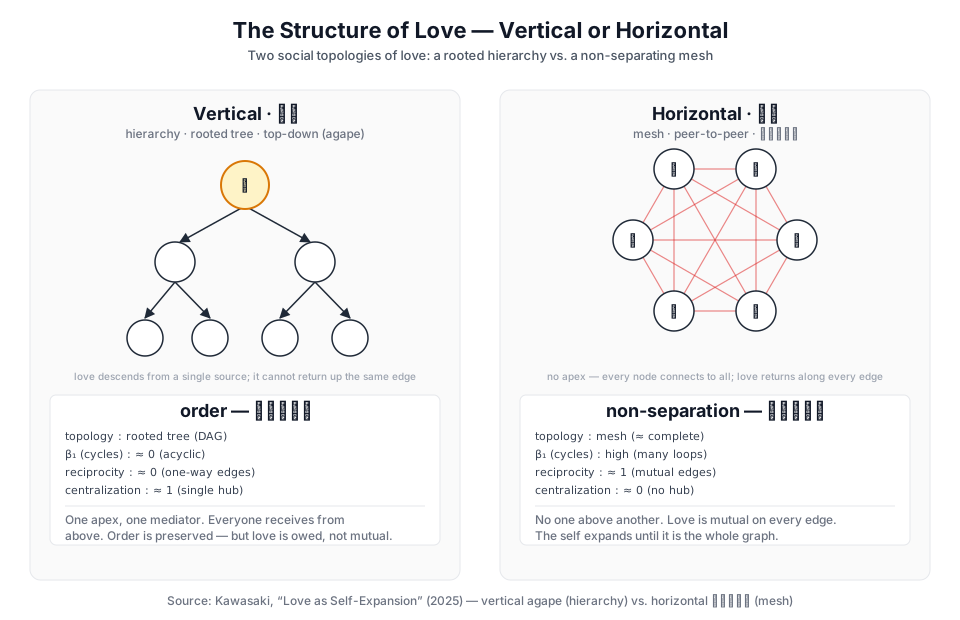
愛の社会構造 — 垂直か、水平か (The Structure of Love — Vertical or Horizontal)
Love does not only have a form; it has a topology. Looked at as a social graph G = (V, E) — vertices are persons, edges are the flow of love — two structures stand apart.
Vertical Love (垂直の愛)
Definition: A rooted hierarchy. A single apex (God, the mediator, the parent) is the source, and love descends one-directionally down the tree.
- Topology: rooted tree — acyclic (
β₁ ≈ 0), one-way edges (reciprocity ≈ 0), one hub (centralization ≈ 1) - Character: order is preserved; love is owed and received, but cannot return up the same edge
垂直の愛は、上から降りてくる。秩序は保たれるが、同じ辺を遡って戻ることはない。 Vertical love descends from above. Order is preserved, but it never returns up the same edge.
Horizontal Love (水平の愛)
Definition: A peer-to-peer mesh. No apex. Each node connects to all, and love is mutual on every edge — this is 自他非分離.
- Topology: near-complete mesh — many cycles (
β₁high), mutual edges (reciprocity ≈ 1), no hub (centralization ≈ 0) - Character: no one above another; the self expands until it is the whole graph
水平の愛に頂点はない。すべての辺で愛は往復し、自己はやがてグラフ全体になる。 Horizontal love has no apex. Love returns along every edge, and the self becomes the whole graph.
True Love (真愛) is the limit of the horizontal structure: as edges complete, the distinction between self and other dissolves into a single connected component. The Boundary Paradox above is precisely the danger of that limit — without conscious boundaries, the mesh closes over the entire universe.
結論 (Conclusion)
Love as self-expansion is not merely an emotion but a fundamental principle of consciousness. The key to healthy love lies in conscious boundary-setting while allowing natural expansion. True love transcends the artificial separation between self and other, but this transcendence must be conscious and intentional.
The ultimate goal is not to eliminate all boundaries but to make them conscious choices rather than unconscious limitations. In this way, love becomes a tool for both personal growth and universal connection.
関連概念 (Related Concepts)
- Self-expansion (自己拡張): The process of extending one’s sense of self beyond traditional boundaries
- Boundary consciousness (境界意識): Awareness of where self ends and other begins
- Non-separation (非分離): The recognition that self and other are not fundamentally separate
- Conscious love (意識的愛): Love that is practiced with full awareness and intention
This dictionary entry represents a systematic exploration of love as a fundamental principle of consciousness expansion, drawing from both Eastern and Western philosophical traditions.