YHWH — I Am That I Am — Part III

YHWH — I Am That I Am — Part III
What is love, what is spirit, what is the self. As a result of learning these, I admit defeat to God and to Christ. But the god I had been trying to kill was not the true God. The final piece of the trilogy.
I Admit Defeat
To put it plainly: I now admit defeat to God.
If I must name it — perhaps to the love of Christ.
In a world of non-separation between self and other, good and evil are ambiguous. More than a shared rightness, one values the air of the room. One prioritizes family, one’s own people. This is not only Japan. China, Korea, Asia share that sense. Fundamentally, kin matter more than law.
Though that is, in truth, nothing but an expanded self.
The Structure of Love — Vertical or Horizontal
This is a digression, but in Japan today, because Buddhism is not learned correctly, the self and the self-other boundary are ambiguous, never properly defined. From this, many social problems arise.
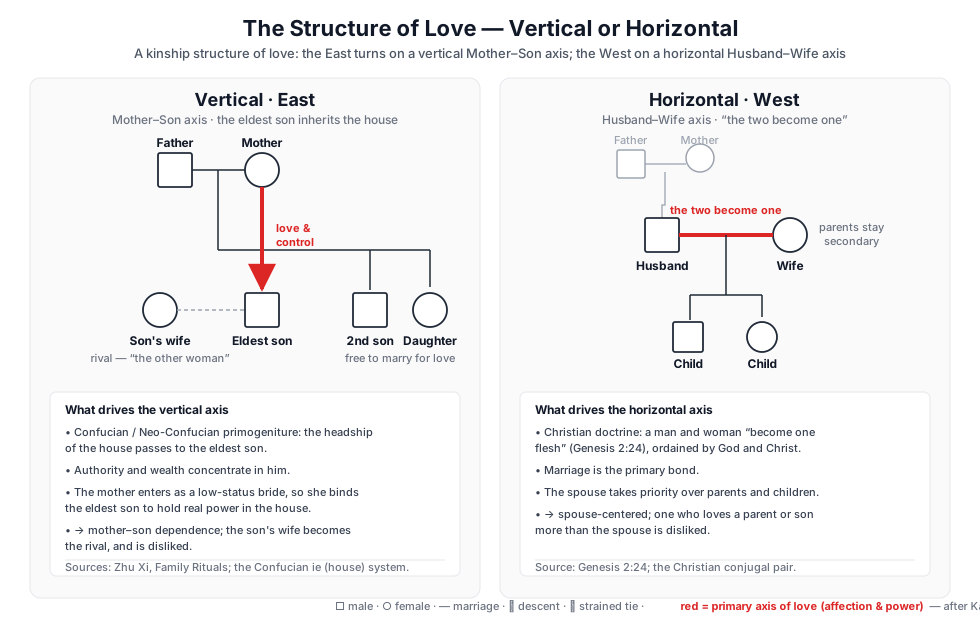
In the West, the mother-fixated man and the boy-fixated woman are disliked. But in the East, it is the independent woman, in the Western sense, who is disliked. This is only a matter of whether the structure of love in the social order — the structure of non-separation — runs vertically or horizontally.
In the East, the structure of love is vertical. This is due to the Confucian, Neo-Confucian institution by which the headship of the house passes to the eldest son (cf. Zhu Xi, Family Rituals). Inevitably, authority and wealth flow to the eldest son. Because each holds their own power dynamics, the mother dotes on and controls the eldest son. Having entered the house as a bride, the mother’s standing there is low, her authority low. The master always holds the stronger authority and property. So the mother strongly controls the eldest son and builds a relation of dependence — in order to hold real power in that house herself.
That is why the mother-son fixation is built into the social structure. In this society, evil is the other woman who steals the eldest son’s love. The woman who asks “me or your mother, which matters more?” is disliked. In this structure, to love the mother is right; the eldest son who loves his wife is not. Incidentally, the second son, third son, and daughters are free to love as they please. Where the headship is unaffected, no control arises.
In the West, by contrast, man and woman become one — because God, because Christ, ordained it so. So the relation of love completes itself horizontally. Man and woman, spouse and spouse. Here the disliked one is the being who loves the son, the mother, more than the spouse.
To hold the wrong structure of love is to create distortion in society. It is precisely that distortion that is disliked.
To Control Love Consciously
The digression grew long, but what I want to say is this: as a result of learning what love is, what spirit is, what the self is, I admit defeat to God and to Christ.
The love of “I exist,” of “God exists,” is lonely. That love is the thing called self. The curse of Mill (1859), of Adam Smith (1776). Through spirit, you cannot escape the freedom of the body, cannot escape love. Ownership, love, spirit — all closed in there.
On the other hand, to expand love without limit, to the whole universe, without contrivance — expanding without perceiving. This does not understand love; it can receive joy, but it makes even the bad, the sorrowful, the unfitting into oneself.
This is true love / bad love / good love.
So I control love consciously. I give priority — to things, to love.
We Are Already Together
After all, I was raised as a subject of the kingdom of God. I follow that heart, in effortless naturalness. Through Christ, I do not love what is not good. I love what I feel to be good.
It is something that has continued for more than two thousand years, and it is the love of God, the love of Christ. I feel it to be agreeable. I accept that sense of feeling. In effortless naturalness.
I do not love everything. Because I am already loved.
This, the hippies already had the answer to (Whole Earth Catalog; Brand, 1968).
We can’t put it together. It is together.
Therefore, I need not love what I cannot love. Even unloved, even with hearts apart, you and we are together.
And on that ground, in light of samsara, I feel: I have no death. I cannot die. There is no separation. People, animals, grasses and trees, the earth, the sea, the universe. Silicon too. They are me. Even the next universe, even the previous universe.
To be liberated is to love and accept the whole samsara of that universe. As a human, to be in the human; as an insect, to be the insect; as a stone, to be the stone. Each moment has its own life. And then — to return.
The God I Was Fighting — God
Yet I go on fighting God.
That god is God. The absolute, universal, eternal, omnipotent god. A made god.
A god made by Rome, by the emperor (cf. First Council of Nicaea, 325; MacCulloch, 2009). A being made to symbolize authority, to instill awe, to rule.
But — the God of Genesis. The God Christ spoke of. Was it like that?
YHWH — The True Name
Concerning YHWH, the name of God spoken in Hebrew — I thought it through. I was a Jehovah’s Witness, after all. Ha.
Not God but YHWH. That is the true name, and I will prove it.
And I recognize the true meaning of YHWH, in Hebrew, to be I am that I am (cf. Cross, 1973; the etymology is debated).
On Mount Sinai (Horeb), before the burning bush, Moses asked God for the name. In Hebrew, Ehyeh asher ehyeh. I am that I am. (Exodus 3:14)
Who was there?
Moses.
Moses made a covenant with God in order to free the Jews from slavery. He made a covenant with himself. That oath still lives today.
It is by no means God. I am that I am. That is the name of God, and the name of Moses, and your name.
You are not separated from God. The name YHWH is your name.
To this, I will bear witness.
References
- Exodus(出エジプト記)3:14–15.
- Cross, F. M. (1973). Canaanite Myth and Hebrew Epic: Essays in the History of the Religion of Israel. Harvard University Press.
- MacCulloch, D. (2009). Christianity: The First Three Thousand Years. Penguin.
- Mill, J. S. (1859). On Liberty.
- Smith, A. (1776). An Inquiry into the Nature and Causes of the Wealth of Nations.
- Brand, S. (Ed.). (1968). Whole Earth Catalog.
- Zhu Xi(朱熹). Family Rituals(朱子家礼).
End — the trilogy “A Declaration of War on God,” “I Cannot Die,” and “YHWH.” From here, spirit in physics and ghost hacker were born.